

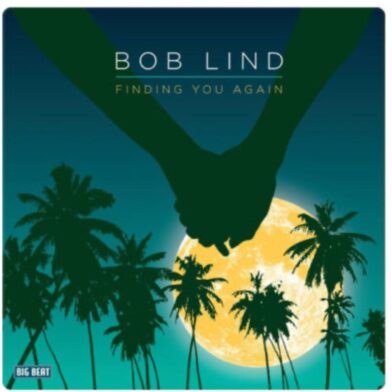
A forty-year absence from the recording scene found troubadour Bob Lind in terrific form. Finding You Again is a triumph from beginning to end.
~updated by popular request
A forty-year absence from the recording scene found troubadour Bob Lind in almost unimaginably terrific songwriting and vocal form. His 2012 release entitled Finding You Again is a triumph of the highest order from beginning to end. Immaculately and movingly produced by Jamie Hoover of the Spongetones, these songs are not merely written or performed; they are, each of them, crafted as carefully and as artfully as Lind’s equally brilliant work from the ’60s and ’70s.
His voice and his musicianship are compelling. One thing is for certain: these songs will last. The album brings to mind Rainer Maria Rilke’s poem ‘Music: The Breathing of Statues’ in which the immortal German poet wrote:
Feelings for whom? Transformation
of feelings to what? Into audible landscape,
Strange land: Music. Space grown from our hearts,
Ours most intimate,
stepping beyond us,
striving afar.”
Bob Lind’s most famous song is, of course, “Elusive Butterfly”, and over the years Lind must have felt imprisoned by the success of this tune. It was not even his best song, but it captured the imagination of millions of ’60s hippies, collegians, protesters and dreamers who were entranced by the beauty of his poetry and the hook-laden production. He made a few records after that, none of them particularly successful, and gained a reputation as a difficult man to work with. Alcohol, ego and the independent streak that often accompanies rare talent were factors in his absence from the record charts, but Lind continued to write, perform and perfect his craft. He has amassed a catalogue of over 300 songs, and has been covered by more than 200 artists including Aretha Franklin, Hoyt Axton, Marianne Faithfull and Eric Clapton.
He has become well-known for delivering particularly affecting stage performances, because despite his characteristic wise-ass attitude (in some respects), you could always count on Lind to write and sing from a unique place: the union of his heart and mind. Bob Lind has been blessed with survival, and as it turns out, the blossoming of his considerable talents. Had Tom Paxton (“Changes’) progressed in his artistry, he might have produced something as fine as Finding You Again. Had John Lennon lived, he might have written something as elegant and as moving as “Someone To Adore” or as balls-to-the-walls as “The Gravity of The World”.
Now I don’t know who or what influenced Lind , but I’d be very surprised if he didn’t dedicate himself (at some point in his life) to the reading of such poets as Lorca, Bertolt Brecht, and the great Russian lyric poet Vladimir Mayakovsky. The images in Lind’s writing, the specificity of his approach, and his commitment to looking towards the sublime are strongly reminiscent of the great lyric poets of the 20th century. I’ll quote from one of the highlights of the record, the truly beautiful ballad entitled “Someone To Adore”:
The song that swells in every beating heart
The theme that throbs in every classic work of art
The drive that draws a man to churches and to whores
Someone to adore”
And the closing track, entitled “Perspective” offers up some wonderful, thoughtful and piercing images, unmatched in the writing of virtually any contemporary songwriter you care to name:
What if you leave me
The faithful moon will keep on rising
Stars will shimmer birds will fly
The nights will fall, and years will slide
Across me
So, the question remains, why release a new album after a 40 years absence. Bob Lind expressed his convictions and decision succintly when he said:
To me, music is simple. You get in a room, or on a stage, or outdoors in the sunshine, and you play a part of your life into the life of someone else… That’s it. It’s direct, it’s immediate and it’s not caged up in time. You say what you have to say and it’s fucking over. It connects or it doesn’t. If it doesn’t, life goes on. If it does, something true and meaningful has happened.
Things changed when he started working with Jamie Hoover, who proved to be both a talented and sympathetic producer. Before Lind knew what was happening, they’d agreed to work on a new recording together. Lind’s suspicions and past experience of the record industry disappeared entirely in his excitement of working with Hoover.
Says Lind, “his love for my music not only brought out the best in his production artistry; it also gave him the downright divine tolerance to put up with my raging temper and often tactless criticism – I’m maniacally defensive of my songs and don’t frame my objections kindly… His mantra was ‘I want you to be happy’. He constantly sought to bring my ideas to life in his unique and creative way.”
Key tracks: “How Dare You Love Me”, “Maybe It’s The Rain”, “Someone To Adore”, and well, pretty much the entire album. It’s a brilliant piece of work, with adult perspectives, witty lyrics, some inspired singing, and above all, the evidence of songcraft that stands far and above almost anything else being released today.
We rate this record as one of the finest Vivascene has been privileged to review in the past fifteen years.


Wonderful to have you back, Bob – we missed you!
We began listening to Bob Lind’s songs back in the 1960s and have been a fan of his music for years. We saw him recently again, after many years, performing near the beach in Carpenteria, California, just south of Santa Barbara. It was a great evening and reminiscent of many shows we saw at the Glendale Ice House and at the Pasadena Ice House when Bob Stane owned and operated the folk clubs during the 1960s. And while we disagree with the reviewer about his best song, certainly his most famous song, and feel it represents not only his best writing and is his best lyrical piece, we are very familiar with allof this recordings and lyrics. The new album is as good as anything he has recorded and it’s great to have him back; but he never really went away, now did he?