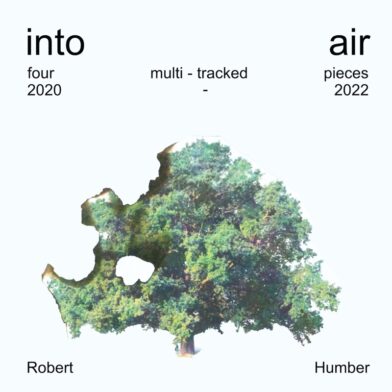
Canadian composer Robert Humber releases a new compilation of four works composed for multi-tracked soloists.
With home studio technology becoming ever more accessible and affordable, multi-tracking has become one of the most vital techniques for exploratory composers of the present generation. Throughout the 1980s artists such as Paul Dolden and Steve Reich (on his Counterpoint series), developed instantly-identifable soundworlds through overdubbing. Now with hardware and software becoming more attainable and easier to manage, numerous artists have discovered ultra-personal idioms within that methodology.
Canadian composer Robert Humber is one such artist. His forthcoming album into air compiles four works composed for multi-tracked soloists between 2020-22. Though this body of work came about on account of pandemic-era necessity, Humber’s command of this tactic is so singular and skilled that limitation is the furthest thing from listeners’ minds.
The fact that the titular composition was awarded 1st prize in the 2024 SOCAN Young Composer Award (Chamber Ensemble) affirms this assertion. The work, scored for fve violins, was inspired by a plane trip that Humber took between Calgary and Vancouver during the height of wildfre season. “I had never seen anything like the endless expanse of smoke that covered the Earth below us,” he recalls. “The implications were terrifying and heartbreaking, yet I couldn’t help but fnd beauty in the ripples of grey, orange and brown.” The peculiar language of the work seems to mirror this friction between destructive terror and strange beauty adopting a bewildering mixture of microtonal infection, fne timbral gradations, elegant melodicism, ferce rhythmic drive and hushed atmospherics. This deluge of approaches fows together seamlessly and the elegant performance of Adrian Irvine serves to solidify this impression.
The album’s second work is mothmouth, which applies a similar sensibility to an ensemble of three classical guitars (all performed by Ben Diamond). Humber cites the foundational collage work of John Stezaker, which aspires to a “cubism of photography” moths and inspirations for the piece. Unsurprisingly there’s a collagist dimension to the compositional process, knitting together quotations from everyone to SOPHIE to Talk Talk, as well as repurposed scraps from Humber’s own discarded pieces.
Where the first two works employ multi-movement structures, murmurations for Stephen Eckert’s stack of six pianos unfolds along a single mesmeric twelve-minute trajectory. Humber’s intent here was to refect nature, and he employs a more improvisational, durational notation to achieve this. Where some aim to portray the tranquility of the natural world, Humber’s approach highlights its dynamism and constant movement. Its frst two minutes narrow from a tangle of vast, eruptive sweeps to a rapidly repeated single note in the upper middle register of piano. It takes twice that duration for listeners to reach a pause in the piece’s giddy fluttering.
murmurations is one of two pieces on the album where Humber and his collaborators employed a DIY approach to recording. On into air,“Adrian recorded violin in his cramped bedroom studio in downtown Toronto,” according to Humber, while here, “Stephen recorded piano in their professor’s campus office (while the hallways of the school were largely vacant, peak pandemic).”
While composing the final work, singing in circles, Humber reveals he felt himself “approaching a breaking point. I was isolated, anxious, and without purpose. It was only the help of some close friends and family that eventually pulled me out.” This sombre work bears a dedication to two of Humber’s key mentors, Andrew Staniland and the late Jocelyn Morlock, whose works “Still Turning” and “Exaudi” respectively inspired the piece. Heather Tuach populates the work’s ensemble of solo cello plus cello octet, the latter of which only appears eight minutes into the 14-minute work. This cadenza-like structure serves to highlight Humber’s deft string writing, its initial section blends yearning lyricism and anguished virtuosity, its technical challenges serving its tense emotional tenor while still remaining idiomatic for Tuach. Recorded in a heritage church in Port au Port, Newfoundland, the rich, natural reverberation frames the cello’s dark hues beautifully.
Embracing aspects from Romanticism to Spectralism, experimental pop to improvisation, into air is remarkable in how it conveys its composer’s eclectic outlook while illustrating his resourcefulness in reconciling these divers interests.
Robert Humber is a Newfoundland-based composer, singer/songwriter, multi-instrumentalist and producer. He has written for concert halls, films, dance, installations and more.
Within the last year Humber premiered a ballet commission from Kittiwake Dance Company as well as a new 30-minute piano/electronics/dance piece in collaboration with Stephen Eckert and Hilary Knee. Other recent projects includesome chords for angel island, a commission from Calgary’s Astralis Quartet, and elegy half erased, a commission from London, England’s Greenwich Trio. Summer 2025 saw the Tuckamore Alumni Trio touring his 2019 piano trio riverspeak around several small communities in Newfoundland and Labrador.
Currently, he is composing music for a CB Nuit-commissioned shadow-puppet ballet inspired by the paranormal folklore of Newfoundland and Labrador. He’s also creating an extended work for contemporary dancer and award-winning cellist Vernon Regehr, as well as a violin/live-recorded cassette-loop commission from Arlen Vriens. His second album as R Sheaves is nearing completion.