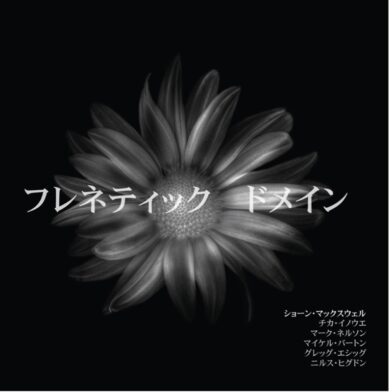
Shawn Maxwell’s distinctively flavored, rhythmically unmistakable compositions have always skirted the neighborhood that Frenetic Domain calls “home.”
~ Courtesy Champagne House Media
Shawn Maxwell has issued a dozen jazz albums under his own name. For Frenetic Domain, available now via Cora Street Records, he chose a different tack. “At heart, I am still the classical clarinetist I was since fourth grade,” he admits. “I didn’t even start playing saxophone till after high school.” That makes him — well, not unique. A healthy proportion of jazz artists start out by studying the classical repertoire; it’s the canon for Western music history as well as the initial instruction manual for most instruments.
So perhaps it’s no surprise that the 20th century — the jazz century — saw a number of attempts to forge a bridge with classical music. Some were considerably more serious than others. In his orchestra of the 1920s, Paul Whiteman aimed for “symphonic jazz” (and included a bevy of violinists to prove his point), even though he didn’t seem to know all that much about either; three decades later, Stan Kenton aimed a battalion of brass, and some extraordinarily intrepid composers, at the same target.
Every now and then, some combo tasks a jazz bassist and drummer with making Bach or Fauré “swing,” or else superimposes Mozartian cadences on a perfectly good jazz tune. The sincerest such experiments populate the “third stream,” which seeks to combine the two disparate traditions at their roots and then build something separate and unique from there.
Maxwell had something like that in mind when he conceived Frenetic Domain. Continuing the account of his early training, “I know I don’t sound like a typical classical guy anymore,” he says. “But I still wanted to use those skills. So I thought about some of the classical clarinet showcases I’d played and decided to compose some pieces with sections that had to be played as written, while still leaving room for a good amount of improvisation.”
Frenetic Domain stands apart from other such attempts in at least one detail, however. It is likely the only jazz-classical hybrid inspired by a 120-year-old manufacturer of reeds for woodwind instruments.
Maxwell serves as an Artist Clinician for Vandoren, the venerable reed and mouthpiece manufacturer. The company sponsors perhaps 50 such artists, in all genres, who regularly visit schools and colleges to share expertise and performance tips with students of all ages. And at one of Vandoren’s national clinician meetings, Maxwell met the classical alto saxophonist Chika Inoue. They became friends, leading Maxwell to teasingly suggest they should record together — a joke based on the fact that he plays jazz, and she doesn’t improvise at all.
But Maxwell soon began to take the idea seriously. He believed that in a hybrid of the two genres, Inoue’s sound and phrasing could lend weight to the composed sections, which would frame and support improvisation from the rest of the group. Most of the soloing would fall to Maxwell and to pianist and longtime collaborator Mark Nelson. (But wanting to involve Inoue a bit more directly, Maxwell wrote out one solo for her to read — the extravagantly detailed, precisely executed passage that begins at 2:05 of “Reed Tire Earth”).
“I hope people will hear this as something different from most of my other albums,” he mentions. Well, yes and no. The inclusion of Inoue, and Maxwell’s decision to tailor his writing around her participation, does indeed make this different in terms of sound.”
And yet, Maxwell has wandered into this patch before, with hard-to-categorize compositions for Alliance, the large-ish ensemble that he convened some years ago to work the territory adjacent to jazz as well as rock. Beyond that, Maxwell’s distinctively flavored, rhythmically unmistakable compositions have always skirted the neighborhood that Frenetic Domain calls “home.”
So yes, the music sounds different. But, he points out, “It’s still me. It’s still my style of writing.”
Note: This press release draws on Neil Tesser’s liner notes.