

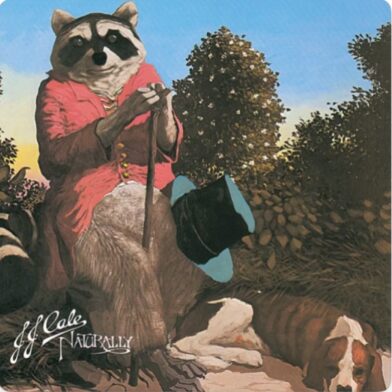
J. J. Cale was the originator of what came to be called the Tulsa sound, which was an amalgam of blues, jazz, and a laid-back intimacy that rendered a dreamy, unforgettable groove.
“I’m a background person. I’m not a household name. People have heard my music, but all my famous songs were made famous by somebody else. . . . But that was my goal.” ~ J. J. Cale
John Weldon Cale, known to all as J. J., was the originator of what came to be called the Tulsa sound, which was an amalgam of blues, jazz, and a laid-back intimacy that rendered a dreamy, unforgettable groove. On his debut album back, Naturally, released in 1971 were several tunes that were destined to become big hits for others, the most notable being “After Midnight”. This was the track that Eric Clapton copped, lick for lick so that his version was not just a cover but a copy.
In fact, it could and should be said that Clapton owed his entire success of the ’70s to Cale, for the Tulsa man’s catalogue ran deep and fruitfully for Clapton on several occasions. Not that Eric was ungrateful. Their collaboration on the 2008 album, The Road To Escondido, won the duo a Grammy for Best Contemporary Blues Album.
Born in Oklahoma City, Cale migrated to Los Angeles in the 1960s and flourished. He began to call himself “J. J. ” so as not to be confused with other John Cale who had been a seminal member of The Velvet Underground. J.J. was a musician’s musician, a guitar wizard who was imitated, but never equalled, by countless rockers and bluesmen for his velvet tone and smooth style that played soft but swung hard. Rock legend Neil Young once described Cale as the best electric guitar player he had ever seen other than the late Jimmy Hendrix.
Key tracks from Cale’s extensive songwriting career include: ‘Cocaine’, ‘Crazy Mama’, ‘They Call Me The Breeze’, and the afore-mentioned ‘After Midnight’. Notable albums include Naturally, Okie, Troubadour, and his final release Roll On from 2009. He can also be seen in a couple of noteworthy films, 10 Days Out (Blues From the Backroads), andTo Tulsa and Back: On Tour with J. J. Cale.

“Send me the money and let the younger guys have the fame.” ~ J.J. Cale
A very nice tribute piece to J.J. Cale, whose laid back bluesy shuffle style of pristine guitar play was repeated all throughout his distinctive catalog. He also was a skilled producer and recording engineer, in addition to being a multi-instrumentalist of note. I’m aware that your dig at Eric Clapton in the 1970’s was an attempt at sarcasm, but there is a tiny grain of truth there. The under-appreciated Delaney Bramlett should receive some credit too, for co-writing six of the songs on Clapton’s self-titled debut in 1970 on which Cale’s “After Midnight” appeared. Delaney was a pretty substantial influence on both Eric and Cale, with both enjoying brief tenures with Delaney & Bonnie. Another Oklahoma native and Delaney & Bonnie band-mate, bassist Carl Radle, was closely connected to Cale and Clapton during the seventies, playing on Slowhand, 461 Ocean Blvd., E.C. Was Here, Backless and Layla, as well as many of J.J. Cale’s LP’s during that period.
It has to be noted that Layla, and Assorted Other Love Songs (perhaps the greatest album of all-time) was also recorded in 1970 without any input from J.J. Cale, but with other artists who had played with Delaney & Bonnie. Cale’s “Cocaine,” recorded on Clapton’s Slowhand, was joined by Clapton compositions “Wonderful Tonight,” and “Lay Down Sally” to help propel the album into the #2 spot on the Billboard 100. Cale once remarked that “he would probably be selling shoes if not for Eric,” but that of course is just a humble man’s modest musings. It however would be a true statement to say that Clapton was the one who made the general public aware of the extra-ordinary songwriting and guitar ability that Cale brought to the table. Eric Clapton’s most recent offering, the excellent Old Sock, contained a previously unreleased J.J. Cale composition (“Angel”) with Cale contributing duet guitar and vocals. Clapton also covered a Cale song (“Traveling Light”) on his brilliant, but not duly appreciated, Reptile album a decade ago. In Clapton’s autobiography he paid tribute to Cale by declaring him “one of the most important artists in the history of rock, quietly representing the greatest asset his country has ever had.”
It is sad that Cale’s only charting top ten hit of his own (“Crazy Mama”) was from his first LP Naturally. The Band, recorded the song on their High on the Hog release (in 1995 after Robbie Robertson had left the group), as well as Rick Danko reviving his take on Live on Breeze Hill and Rick Danko in Concert. Santana did a cover version of “Sensitive Kind” on his Zebop album. Many others have covered Cale’s songs, and numerous fine musicians, such as Mark Knopfler, have credited Cale with being a major influence.
For those not familiar with J.J. Cale’s catalog, in addition to all those so rightly mentioned above; I recommend J.J. Cale Live, which includes “After Midnight,” “Call Me The Breeze,” and “Cocaine,” as well as other Cale classics such as “Mama Don’t,” and “Magnolia.” Okie is also a personal favorite that has stood the test of time and contains perhaps my favorite Cale song “I Got The Same Old Blues.” I have also been listening to Travel Log a lot the past year or two, and the guitar playing on it is inspired, just like on all Cale records.
J.J. Cale was never exceedingly showy or flashy, but he sure was a very special talent.