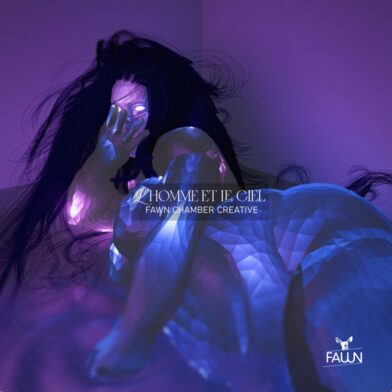
The opera l’homme et le ciel marks the recorded debut of FAWN Chamber Creative and the full-length debut of award-winning composer Adam Scime.
~ slated for release with Vancouver’s Redshift Records on CD and digitally
~ Courtesy Riparian Media
The opera l’homme et le ciel marks the recorded debut of FAWN Chamber Creative and the full-length debut of award-winning composer Adam Scime, two vibrant beacons within Toronto’s artistic landscape. Founded in 2012 by its artistic director Amanda Smith, FAWN Chamber Creative has produced seventeen shows and supported the development of nine new operas, with three currently in progress. The company is dedicated to experimental music and contemporary opera, with a particular emphasis on collective and devised creation processes.In 2020, FAWN’s triple-bill of collaborative creations Pandora received two Dora Mavor Moore Awards nominations for Outstanding Production and Outstanding Direction. FAWN has since become known for bold, boundary-pushing work that challenges operatic form and engages adventurous, unconventional audiences. Scime has served as the musical director of FAWN for a decade plus, and has been involved with it in various creative capacities since its inception. The vigour of the performance that this recording documents are a testament to this longstanding relationship.
This particular opera has been presented three times by FAWN in various forms, prior to being recorded. It was frst offered as a workshop/semi-staged presentation in spring 2013—during the organization’s second year—at Toronto’s Ernest Balmer Studio with support from Tapestry Opera and featuring the ensemble Thin Edge New Music Collective. Later that same year it was featured at Kitchener’s Open Ears Festival, the long-running festival where Smith now serves as artistic director. In December of 2015, the full production was mounted as a co-presentation with legendary Toronto venue, the Music Gallery.
Ian Koiter’s original libretto was based closely on The Shepherd of Hermas, an anonymous text from the second-century Roman world, a work featuring apocalyptic, otherworldly visions, and an arresting portrayal of a man’s confrontation with the truth about his desires. Across four scenes, FAWN offers a secular reimagining of the enslaved Hermas’s journey, using the distant world of the original as a lens through which to examine something enduringly human: the psychological pull of desire and temptation.
Temptation is treated less as an external force than an interior one in the dramatic interpretation of l’homme et le ciel. Hermas moves through a landscape in which longing continually alters his perception of himself and the world around him. Desire can be beautiful, unsettling, obsessive, or feeting; it can illuminate something hidden within us even as it threatens to distort what we see. The four scenes trace this shifting inner terrain, allowing the boundaries between memory, impulse, imagination, and reality to become increasingly uncertain.
Scime’s musical treatment of this succession of psychological states is fttingly dynamic. Scored for baritone, and two soprano voices plus a sextet of violin, cello, fute, clarinet, piano, and percussion, the four primary scenes are interleaved with shorter electronic interludes that align with the two visions that appear throughout. Scime’s soundworld teems with timbral, harmonic, and gestural variation while exploring gradations of density. It also doesn’t shy away from various unconventional instrumental and compositional techniques spanning microtonal elements to piano harmonics. All of these elements serve as an extension of the opera’s protagonist and envelop listeners in a vividly hallucinatory environment. Yet there’s also, an unmistakable luminous quality that underpins the swirling mass of musical information, one that’s audible in the cascading woodwind gestures and splashing crotales in the frst scene, and that blossoms throughout the spacious passage of scene two’s second section. Even when this light shines faintly, its coruscating presence connects Scime’s assured individualism obliquely to a lineage that stretches from his contemporaries such as Zosha Di Castri, back to Saariaho, Grisey, Vivier, through Dutillieux and Messiaen, and back to Debussy.
Fêted Canadian-Korean singer Clarence Frazer plays Hermas, carrying the narrative throughout its four-scene-arc, and animating the role with his varied vocal experience. Alexandra Smither, touted by the New Yorker as “a fast-rising, British-Canadian soprano with a crystalline, agile voice” appears as Hermas’ master, Rhoda, evoking the mixture of poise and authoritarian resolve demanded by this part. Xin Wang (soprano) is cast as the Messenger—a being of ultimate beauty and fear who appears to Hermas in a dream, according to the opera’s synopsis—and brings a suitably otherworldly quality, especially as she reaches high into her upper register. Given the kaleidoscopic fervour of Scime’s music, it’s no surprise that the instrumental ensemble features some of Toronto’s finest contemporary music interpreters. Amahl Arulanandam (cello), Sara Constant (fute), Nathan Petitpas(percussion), Wesley Shen (piano), Anthony Thompson (clarinet), and Leslie Ting (violin), are each versatile and imaginative players in their own right.
Ultimately l’homme et le ciel is a potent and disorienting recording that sees Ian Koiter’s dizzying script brought to life through the colour and detail of Scime’s score as well as the crisp decisiveness of the music’s execution.
Adam Scime is a composer, performer, writer, and educator who works in varying environments related to performance, opera, theatre, music, and sound. Scime’s work is rooted in collaboration. His creative process is informed and supported by the collective fabric of artistic meaning-making processes, the cultivation of empathy, and learning how to reinforce positive collaborative spaces.
Scime’s music has been commissioned and performed widely across Canada, Europe, and Asia or described as “Astounding, the musical result was incredible” (icareifyoulisten.com) and “a fantastic success” (CBC). His work has received many awards including the 2015 CMC Toronto Emerging Composer Award, The SOCAN Young Composer Competition Orchestral Category, The Karen Keiser Prize in Canadian Music, and The Esprit Young Composer Competition, and frst prize in the 2018 Land’s End Composer Competition. Other highlights include Scime being selected as a 2020 Toronto Symphony Orchestra NextGen composer and touring with the ECM+ 2016 Generations Project during which his piece Liminal Pathways was performed across nine Canadian cities.
His work has been performed and commissioned by many renowned organizations, ensembles, and soloists including The Toronto Symphony Orchestra, Nouvelle Ensemble Moderne, The Esprit Orchestra, Array Music, The National Arts Centre Orchestra, The Hamilton Philharmonic, l’Orchestre de la Francophonie, The Gryphon Trio, New Music Concerts, Soundstreams, Tafelmusik, The This Edge New Music Collective, and The Bicycle Opera Project, among many others.
Amanda Smith is a Toronto-based stage director, dramaturge, and producer whose artistic practice is rooted in exploration, collaboration, and new creation. Working across opera, new music, and interdisciplinary performance, she specializes in devised opera, experimental performance, and the development of new work that brings together artists from diverse disciplines to create unexpected performance experiences.
Amanda is the Founding Artistic Director of FAWN Chamber Creative in Toronto, where she commissions, develops, produces, and directs new opera, experimental music, and interdisciplinary performance projects. Beginning with the 2026/27 season, she also serves as Artistic Director of Open Ears Festival of Music and Sound in Kitchener-Waterloo. For more than 15 years, Amanda has explored collaborative approaches to performance-making, including devised creation, design dramaturgy, and interdisciplinary research. Her work investigates how creative processes shape artistic collaboration and how encounters between different artistic practices transform the ways artists create and audiences experience live performance.
Amanda holds a Master’s in Interdisciplinary Studies from York University. Her research examined the intersections of devised theatre, musical improvisation, and social psychology, exploring how devised opera methodologies relate to empathy among artists and audiences while identifying the processes of care that make this kind of collaborative creation possible.
Through FAWN Chamber Creative, Amanda has led the creation and presentation of seventeen productions and contributed to the development of nine new operas. Notable projects include the aforementioned Pandora; Belladonna, a co-composed queer techno opera; and Cells of Wind by Anna Höstman and Oana Avasilichioaei, a graphic-score opera exploring solitary confinement. Recent directing and creative credits include Come Closer andThe Turn of the Screw with Opera 5, Entropy with the Improvisation Convergence Ensemble at Wilfrid Laurier University, Berio’s Sequenza III for New Music Concerts, and a double bill ofThe Seven Deadly Sins and Lucrezia for the Glenn Gould Opera School. She has also created work for Tafelmusik Baroque Orchestra, Against the Grain Theatre, Musique 3 Femmes, Opera in the 21st Century at the Banff Centre, Cowtown Opera, Stratford Summer Music, and numerous independent collaborators across Canada.
Librettist Ian Koiter grew up in Midland, ON, and holds a Bachelor of Music from Western University and an MA in Religious Studies from McMaster University. Now based in Toronto, he works as a composer and collaborative musician, an educator, and a church musician. As a bassist and keyboardist, he has played with Juno Award-winning rapper Shad for over 20 years, among other artists.