

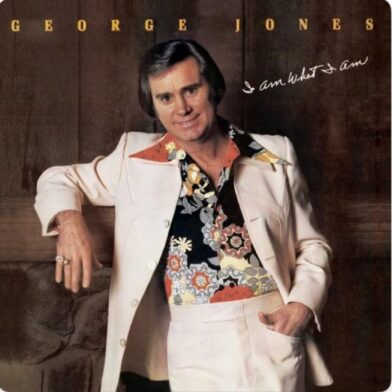
George Jones set the stage for pop and rock audiences to take country music seriously. His way with a song surpassed any classification.
George (No-Show) Jones, the hard-living, hard-drinking, drug-using, multi-divorced country singer passed away in 2013 in a Nashville hospital at the age of 81. Born with a broken arm into a working class family in Saratoga, Texas, he took up the guitar at the age of nine soon found himself a teenage radio start. He went on to become one of country music’s great singers, with a legacy just as powerful as that of Hank Williams. He is certainly much more than a country singer, for his way with a song surpassed any categorization of genre you might care to apply. He was a great singer, period, with a power to move the listener emotionally in ways that only Patsy Cline achieved.
Frank Sinatra was perhaps his most surprising fan. He called George Jones “the second-best singer in the world.”
George lived longer, drank harder and eventually straightened out thanks to Nancy Sepulveda, his fourth wife. She took on the challenge of managing George’s complicated business affairs and a streak of bad behaviour that made many a rock star look, well, like the kids they were. Whatever else can be said about George Jones, and plenty can and should be, he was a hell-raiser outside the music world and a veritable genius within. Ask Dwight Yoakam, Randy Travis, Toby Keith and Tim McGraw, as well as one Garth Brooks: they learned their licks from George Jones, even if they never quite managed to sing as well, write as well, or carouse as often.
George had his first big hit in 1955 with the memorable “Why, Baby, Why”, a song that was brilliantly covered by The Secret Sisters. That smash hit brought him co-billing with Elvis Presley on the Louisiana Hayride. Jones released his final album in 2008, the uneven Burning Your Playhouse Down, which featured duets with some heavy duty stars in and out of country music, from Ricky Skaggs to Shelby Lynne to Keith Richards and Marty Stuart.
Over the course of those fifty-three years George Jones worked with Melba Montgomery and Tammy Wynette (whom he notoriously married and divorced in drama that goes way beyond believability) and a host of other great talents who simply loved working with George, his songs, and his marvellous baritone voice. Only Eddy Arnold ever scored more Top Ten hits in the country music field than George Jones.
His most memorable works were “He Stopped Loving Her Today”, his 1980 recording of lost love that is as heart-breaking a number as has ever been written, and “She Thinks I Still Care”, a ballad so over the top with regret and loneliness that it might well have come from that country poet of misery, Don Gibson. The song was written by Dickey Lee and Steve Duffy. George Jones was the first to record the composition. The single came out in 1962 and remains today a model of vocal performance and sensitive interpretation. This song set the stage for his transformation into a supreme vocalist. It has since been recorded more than a thousand times, notably by Elvis Presley and Teddy Thompson, but never so well as by Jones.
His album from the early Seventies, entitled The Grand Tour, is a tour de force of country weepers, the title tune being a classic tale of lost love. His 1980 album, I Am What I Am, is one of the great country records of the decade, displaying Jones at his mature best, and backed by some of the finest Nashville musicians ever assembled. It has an overall integrity from beginning to end seldom seen in the country vein.
George hardly confined himself to his best selling cry-in-your-beer ballads, which were produced mainly by Billy Sherrill. He could rock it out too, as proved by his innumerable country-honk hits.
He hit it big in 1978 covering Chuck Berry’s “Maybelline” as a duet with Johnny Paycheck. More importantly, the confessional “Bartender’s Blues”, a duet he recorded with James Taylor (and written by Taylor) that year, resurrected him in the public eye after some years of bad behaviour, no-shows at concerts, and typical Jones rowdiness. He never quite gave up those extremes, though, crashing his car in 1999 while under the influence of alcohol, which subjected him to arrest and a spell in rehab. Throughout it all, he kept writing, singing, recording, and performing, both brilliantly and erratically it must be said.
His legacy is so much greater than that of a solo artist: he was in fact the interpreter and performer of dozens of great songs, and dozens of collaborations with other great artists.
His two 1965 albums with Gene Pitney were the first ever studio sessions between a hard-core country singer and a pop star, and set the stage for pop and rock audiences to take country music seriously. And “Why, Baby, Why” is the prototype for every rockabilly song that was ever written: hard-driving, up-tempo, and completely contagious. He followed that up with the unforgettable best-seller “White Lightning”, a humorous tale of powerful home-brew.
George was a musicologist in the best possible sense, making tribute albums that meant a great deal to him: entire albums comprised of material from the likes of Hank Williams, Texas swing king Bob Wills, the legendary Leon Payne, and hillbilly rarities. In all he recorded more than 80 albums with a vast scope of new and old material, 69 of them solo works, and 11 duet albums.
As for his ballads, no less a leading light of Americana, Gram Parsons, called George Jones “The King of Broken Hearts”, which had proven to be an apt title of a Jones album from 1964. There is no finer accolade for one of the great singers of all time.


George Jones was a true legend whose timeless music and unrivaled voice continue to inspire and resonate with fans of all generations.