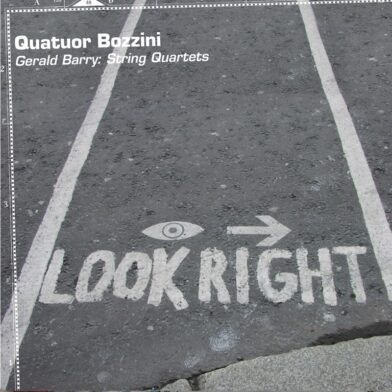
The Montreal ensemble presents Gerald Barry’s four String Quartets for the very first time on a commercial recording.
~ Courtesy Riparian Media
Quatuor Bozzini has a longstanding relationship with the GRAMMY-nominated Irish composer Gerald Barry, one that dates back to their third concert season some 24 years ago, when they premiered his String Quartet No. 2, “1998.” Since then, they’ve performed his work in concert on 19 other occasions, including programs at London’s Wigmore Hall, the Huddersfeld Contemporary Music Festival, Festival van Vlaanderen Kortrijk (Belgium), and Klangspuren Schwaz (Austria).
Among the foremost aspects of the Bozzinis’ ensemble identity is their interest in endorsing unconventional compositional voices rather than well-established schools of thought within contemporary music. Barry’s musical approach, with its unusual and abrupt contrasts, blunt edges, strange humour and refreshing economy of material, fts right in with their vision. Born in 1952, Barry was also a student of two notable 20th-century mavericks, Stockhausen and Kagel, but his work has little clear resemblance to either. Tom Service, writing in the Guardian discusses how his “compositional thinking displaces the familiar to find something unexpected – yet something that is unexpectedly, searingly right when you hear it” and later offers that “his music sounds like no one else’s in its diamond-like hardness, its humour, and sometimes, its violence.” Over the past two-and-half decades, they’ve juxtaposed his pieces with fellow eccentric Bozzini favourites such as Martin Arnold, Cassandra Miller, and Michael Oesterle.
It’s fitting, therefore, that the Montréal ensemble’s forthcoming recording celebrates the unostentatious iconoclasm embodied by Barry’s four string quartets, which they have assembled here for the very first time on a commercial recording. Rather than move chronologically, the album begins with the third quartet, Six Marches composed in 2001, a decision that plunges the listener into one of the cycle’s most aggressive passages straight away.
The frst movement bears the apt subtitle “Savage and then Calm” and its frst half inhabits a bloody-minded resolve that might recall Ustvolskaya, before a minute and thirty seconds later converting this same spartan material into delicate, plucked counterpoint. “Sad and then Harsh” repeats the same material three times with diferent instructions for each repetition. The ultra-chromatic harmonic language remains and following the initial pass of the material but before the inevitable jump into harsh, Barry has the quartet adopt a queasy, exaggerated vibrato that quivers nervously rather than providing emotive warmth.
The even shorter “Æneas and Dido,” cast entirely in pizzicato, has a more folkish feel to its gestures but retains the perverse quality of the previous sections by way of its strange, hiccuping rhythms. “Pale” provides a brief passage of unadorned lyricism before the relentlessly strident “Vienna” ofers its pungent reply. “Strength with Ghost at the End,” the longest movement at close to four minutes, seems to emerge from the same brusque urgency at first, before the material repeats, succumbing to a gelatinous trembling redolent of the one found in the second movement. The titular ghost? A wispy, fifteen-second coda that follows the final note and ultimately concludes the piece with something tentative and peculiar.
The curtness of the third quartet’s six vignettes are contrasted by the remaining works, which all unfold within single movements. Writing on the second quartet, 1998, which follows in track listing, the composer himself states “because there are no signposts it is very difficult to foresee the music’s destination at any point — it is resolutely inconstant. If it were a painting it would be abstract with occasional fgurative imagery — a thigh, a calf, those sounds which reassure — but these are illusory and unreachable.” Indeed, there’s an elusive quality to the twenty-one minute piece which feels as though it is in constant flux and motion but without ever straying from the landscape it establishes at its outset. Even in its final third, when things audibly expand in register, orchestration and note duration, the quartet seems to continue orbiting the same topography, punctuated with shuddering tremolos found throughout the work.
Barry’s first quartet was originally composed in 1985 for the Arditti Quartet and subsequently recorded by the Xenia Ensemble, before being revised in 2015. Borrowing material from his opera The Intelligence Park (composed 1981-90), contrast is a key feature of this work again but the sonic baseline of the work resides well within the strings airiest dynamic and timbral region. Its opening minute is a slow, soft single line of harmonics that gives way to a sumptuous and melancholic full-group response. The ensemble texture is retained, but they all shift back to the transparent gossamer of harmonics. Another, shorter deviation, occurs before they make the return the high, whispery procession. Then, around the half-way mark, there’s a quiet but nonetheless dramatic shift. The harmonics vanish, only to be replaced by rapid chromatic scalar fgures that swirl throughout the ensemble. The contrasting, quasi-romantic lyrical passages remain though, and this new alternation carries the listener to the end of the work, where they’re given a longer glimpse of this material that ultimately stops part way through.
His fourth quartet was the only other to see a prior commercial release, this time via Crash Ensemble on the NMC imprint. First Sorrow (2006-7) concludes the release with a soft-loud structure reminiscent of the ones found in the third quartet. Its title references a Kafka story of the same name about a trapeze artist who is happy only when aloft. The earlier part of the piece favours harmonically-transparent duet textures that are passed throughout the quartet, save for a part where the violins and viola all converge on a unison melody against the cello, and are instructed to employ microtonal vibrato akin to that of a musical saw—a wonky approach that indirectly forecasts the piece’s surreal ending.
After a period of deep hush, with four minutes remaining in the work, everyone jumps in together as the tempo and urgency increases. There’s a sense of unhinged feverishness that persists for half of this final stretch, before things slow down and the players break out into an approximation of a hymn-sing. They collectively intone a text based around Twinkle Twinkle Little Star with rectangular insistence that is mirrored in their self-accompaniment but despite this deliberately prosaic approach, the impact is strange and otherworldly wrapping up this collection in a manner that epitomizes the uniqueness of Barry’s craft. As the disc’s liner notes conclude: “in a landscape that often aestheticises ambiguity, Barry’s work is aggressively clear-edged: you always know exactly where you are, and it is rarely where you expected to be.”
Gerald Barry was born in Clarehill, Clarecastle, County Clare, Ireland, in 1952. Barry’s extensive orchestral catalogue includes several works commissioned by the BBC: Chevaux-de-frise (1988 BBC Proms), The Conquest of Ireland (1996), Day (2005/14), The Eternal Recurrence (2000, setting Nietzsche for voice and orchestra), and Hard D (1995) for Orkest de Volharding. No other people was presented at the 2013 Proms with the BBC Scottish Symphony Orchestra and Ilan Volkov. Canada (2017) was premiered at the 2017 Proms by the City of Birmingham Symphony Orchestra (CBSO), tenor Allan Clayton, and conductor Mirga Gražinytė-Tyla, later receiving its US premiere at Tanglewood (2019). Humiliated and Insulted (2016) was co-commissioned by RTÉ and the Royal Scottish National Orchestra.
His growing body of concertos includes the Piano Concerto (2012), written for Nicolas Hodges and premiered in Munich in 2013, with subsequent performances by the CBSO, Avanti! Chamber Orchestra, Britten Sinfonia, RTÉ NSO, and Cabrillo Festival under Cristian Măcelaru. The Organ Concerto (2018) premiered in March 2018 with the CBSO, followed by performances with the London Philharmonic Orchestra, RTÉ NSO, and Deutsche Kammerphilharmonie Bremen under Duncan Ward. His Viola Concerto (2018–19) was premiered by Lawrence Power with Britten Sinfonia and Thomas Adès; the Cello Concerto was premiered by Adrian Brophy and the RTÉ Concert Orchestra at Cellissimo 2022; and his concerto for double bassist Matthew MacDonald and the Berlin Philharmonic premiered in June 2022.
Notable chamber works include Wiener Blut (2000), Dead March (2007), and Beethoven (2008), written for Birmingham Contemporary Music Group. God Save The Queen (2001) was commissioned by the Southbank Centre for London Sinfonietta. Other works include Le Vieux Sourd (2008) for piano, Feldman’s Six-Penny Editions (2008/9), and No people. (2013) for Ensemble 7Bridges.
His seven operas have resulted in collaborations with major conductors such as Barbara Hannigan and Thomas Adès, the Royal Concertgebouw Orchestra, the Almeida and Aldeburgh Festivals, English National Opera, Theater Basel and presentations at Covent Garden. His fifth opera,iThe Importance of Being Earnest (2009–10), won a 2013 RPS Award, received a 2016 Grammy nomination, and has been staged at Covent Garden and Lincoln Center. Barry’s music is published by Schott and recorded on the NMC, Black Box, Marco Polo, BVHaast and Discovery labels.
Quatuor Bozzini has been an original voice and strong advocate in new, experimental and classical music since 1999. Driving the hyper-creative Montréal scene and beyond, the quartet cultivates an ethos of risk-taking, experimentation, and collaboration, venturing boldly of the beaten track. With a rigorous eye for quality, it has nurtured a rich and diverse repertoire, regardless of trends, and leading to a great number of commissions and some 500 premiered works. Its open, collaborative, artist-led approach has resulted in the realization of numerous innovative and highly praised productions, including inter-disciplinary projects with video, theater and dance.
To ensure the continual development of the artform, Quatuor Bozzini’s musical ‘laboratories’, the Composers’ Kitchen, Performers’ Kitchen and Bozzini Lab, work to mentor and support new generations of composers and performers. The quartet runs its own recording label, Collection QB, and has released many critically acclaimed albums which have become reference recordings in the field. They have also issued albums with Wergo-Deutscher Musikrat, Edition Wandelweiser, Another Timbre, Hubro, Kairos, Unsounds, Prospero, Late Music, Black Trufe, NMC, New World Records, HCR, Tour de Bras, ATMA Classique, and Centrediscs.
Praised by its “intense musicality and immense sensitivity” (Musicworks, Canada), Quatuor Bozzini was qualifed in the Bandcamp Daily as “one of the most daring string quartets of the entire world.” Quatuor Bozzini is a self-managed organization, producing a concert series in Montréal and touring extensively in Canada, the USA, and Europe. Notable festivals and venues include MärzMusik, Klubkatarakt, Darmstadt, Wittener Tage (DE); Wigmore Hall, Barbican Centre, Southbank, Aldeburgh, Huddersfeld, Sound Scotland, Dartington (UK); Festival d’Automne, Musica Strasburg, Riverrun (FR); Angelica (IT); Ultima (NO); Gaudeamus, Muziekgebouw, Orgelpark, NovemberMusic (NL); Rainy Days (LU); Kortrijk, Transit (BE); Musik Festival Bern, Lugano Arte e Cultura (CH); Dark Music Days (IS); Time of Music (FI); Ostrava Days (CZ); Klangspuren Schwaz, Porgy&Bess (AT); SIPFEST (ID); Tsuda Hall (JP); TIMESPANS, Bang on a Can, Roulette, Other Minds, Frequency (USA), Yeni ve En Yeni Müzik Festivali (TR).
Quatuor Bozzini has earned widespread acclaim and numerous awards both in Canada and internationally. A JUNO Nominee for their album Short Stories, the ensemble was also named a fnalist for the Grand prix du Conseil des arts de Montréal. Recognized for their artistic excellence and dedication to new music, the quartet has been honored multiple times by the Conseil québécois de la musique, notably winning the prix Opus for Performer of the Year and the International Outreach award. Their contributions and recordings have also earned them: the Förderpreis Ernst von Siemens Musikstiftung, the Friends of Canadian Music Award, the German Record Critics’ Award for their album Arbor Vitae and the Étoile-Galaxie Prize from Radio-Canada.