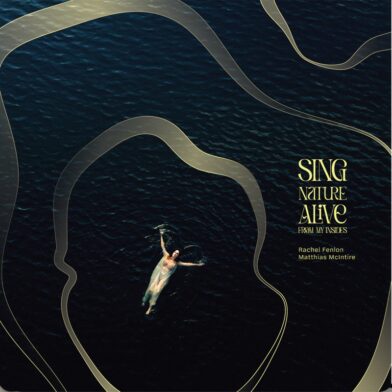
Canadian soprano and pianist Rachel Fenlon, composer Matthias Mcintire and filmmaker Jamie A. McMillan present a 40-minute multimedia song cycle.
~ released on Redshift Records, December 11, 2026 on CD and digital platforms
~ Courtesy Riparian Media
Sing Nature Alive From My Insides from vital Halifax, Nova Scotia-based composer Matthias McIntire, vocalist and pianist Rachel Fenlon, and filmmaker Jamie A. McMillan presents something downright singular. Its powerful, visceral, and decidedly multi-sensory exploration of some of today’s most pertinent themes is bolstered by a coalescent collaborative model that manages to maximize each individual’s skill and vision.
Not only does this 40-minute multimedia song cycle for soprano voice, piano, and electronics tap Fenlon’s unique performance capabilities, it’s built upon a textual foundation consisting of her poetry. In many regards, these texts provide the engine of this project, their thoughtful and vulnerable meditations on the natural world and its increasing fragility informing its musical and visual tenor.
The aforementioned virtuosity that distinguishes Fenlon as a vocalist is her rare mastery of self-accompaniment on the piano. Over the past few years she has ascended to critical prominence in the wake of her unprecedented 2024solo recording of Schubert’s monodrama Winterreise—the only commercial release to document a single artist playing both the piano and vocal parts simultaneously.
McIntire and Fenlon frst met in 2018 when both had been programmed on the same festival bill and found themselves mutually drawn to one another’s sensibilities. Some initial, informal improvisations ensued, leading to remote conversations, which then evolved into an actual residency in New Hampshire where they established this project’s conceptual framework: bringing poetry and music together around a shared love of nature in the face of climate change’s rapid acceleration.
The integrated vision the two have cultivated alongside filmmaker Jamie A. McMillan, whose 40-minute flm serves as a vivid visual extension of the thematic landscape charted in the texts. Following the work’s successful 2022 unveiling at Ottawa Chamberfest (without said visual component), all three artists hunkered down at Pontiac Enchanté / Venturing Hills Farms in Québec’s Gatineau Hills. Keeping long hours, they recorded the music while also shooting McMillan’s flm, the converted horse barn serving as their recording studio. The work’s full-fedged, multimedia debut thrilled audiences at the 2025 SXSW Festival (Austin).. The work has also been programmed at Classical NEXT earlier this year in Budapest as well as at Berlied Festival (Berlin),, Sweetwater Festival (Owen Sound), BarokkiKuopio (Finland) and beyond. Sing Nature Alive will be featured at Koerner Hall on January 23, 2027, presented by 21C Festival.
As the album’s liner notes reveal, “all aspects of the project were developed in parallel, with the music, poetry, and images in direct dialogue, creating a shared language for artistic expression that is difficult to articulate in the face of environmental change on such an immense scale.” And, further upending the collaborative conventions of concert music, McIntire and Fenlon’s roles crisscross on throughout the piece with the former serving as poet for the third section, and the latter composing the music for the seventh part.
Sing Nature Alive From My Insides also dispenses with another crucial orthodoxy: McIntire’s music dispenses with the supposed boundary between a traditional and experimental compositional language. At many points throughout, the music transparently celebrates the romantic art song tradition, employing chromaticism-laced harmony alongside matching Fenlon’s evocative full-throated delivery. Yet there’s far more to it than that. With feld recordings, live processing (also executed by Fenlon), extended piano techniques and detail immersives environments, the work draws from exploratory tendencies within and outside the bounds of contemporary concert music acknowledging various forms of abstract electronica as well as the reappraisal of New Age within the past decade or so. The merging of genres and live sound manipulation both reach their peak simultaneously.
Ironically, given its name, the fifth and titular section of the piece obscures the live singing amidst a swirling mass of field recordings and urgent whispers and a chorale Fenlon plays on a keyboard using a sample of her own voice. The following section, “Drowning Crow/ Breath Aria” features spoken texts that echo violently across bit-crushed retro-futuristic synths. Then, following a haunting, protracted passage of what feels like desperate gasping, all the accoutrements fall away for “Where Do The Breathless Souls Go?” a brief and poignant solo voice piece.
As such the sonic blend mirrors the text, with its dream-like strains of pastoral impressionism intertwined with passages of harrowing ecological horror. The woven stylistic approach produces a sort of timelessness redolent of the text’s affnity for nature, while the fragmented contemporaneity that occurs throughout complements the friction inherent to its environmentalist pleas.
On the topic of collapsing boundaries, it might seem obvious to note how Fenlon’s dual role bridges the vocal-accompanimental divide, but it bears emphasizing due to both how audible it is and how it follows the thematic thrust. Vocalist-and-pianist duets aspire to what she achieves: a seamlessness of breath and momentum. This characteristic of the performance serves the ecological stance McIntire, Fenlon and McMillan are advancing here, the unified respiration of the musical organism paralleling the precarious symbiosis we all share with the earth.
As such, Sing Nature Alive From My Insides is aptly titled. It deploys what the project’s collaborators term a “dream form” to channel the visceral impact between as one’s love of nature gives way to fearing for its destruction. This structural concept was inspired by a phrase from Margaret Atwood’s Oryx and Crake: “We’re hard-wired for dreams […] We’re hard-wired for singing. Singing and dreams were entwined.” The assortment of elements and concepts presented cohere into a potent, cohesive statement that expresses affection, longing, anxiety, and grief in the face of climate change, while positioning these concerns inseparable from its human relationships.
Rachel Fenlon is a soprano and pianist who has carved a unique voice on the classical stages of the world. Known for performing self-accompanied song recitals as both singer and pianist, she also appears widely as a chamber music and opera soloist. Her debut album,Winterreise (October 2024), received widespread acclaim, named Album of the Week by BBC Radio 3, CBC, and Gramophone Magazine, and Album of the Month by Classic 106 FM. CBC praised it as “an outstanding new record… extraordinary,” and BBC Radio 3 called it “extraordinary and spellbinding.”
Fenlon has performed across Europe, the UK, Canada, Asia, Brazil, and the U.S., with self-accompanied performances at Konzerthaus Berlin, Martha Argerich Festival, Premier Performances Hong Kong, Juan March Madrid, Vancouver Recital Society, Oxford Lieder Festival, Music Toronto, Salle Bourgie Montreal, Settimane Musicali di Ascona, and the National Arts Centre. Fenlon has also collaborated with a vast array of composers including Sarah Slean, Samy Moussa, Nicole Lizée, Chaya Czernowin, Martín Schüttler, Helmut Zapf, and Danika Loren.
Canadian composer, performer, and educator Matthias McIntire has followed a unique musical path and his compositions reflect his eclecticism in performance (violin, viola, voice, and electronics), Western classical and new music, as well as jazz, fiddle, free improvisation, field recording, foley art, and electronic music.
Named a 2026/27 NextGen Composer by the Toronto Symphony Orchestra, winner of the 2021 Karen Kieser Prize, and the recipient of 10+ creation grants, McIntire’s compositions have been presented internationally by artists, ensembles, and festivals including Dinuk Wijeratne, the Verona Quartet, cellist Arlen Hlusko, pianist Tong Wang, Duo Holz, New Music Concerts (Toronto), Harbourfront Centre (Toronto), the Manitoba Chamber Orchestra, Hamilton Philharmonic, Edmonton Symphony Orchestra, the Center for New Music (San Francisco), One Found Sound (San Francisco), the Curtis Institute of Music (Philadelphia), the University of Seattle (Washington), New Music for Strings (Iceland), among others.
McIntire is based in Halifax, Nova Scotia where he teaches Composition and directs the New Music Ensemble at Dalhousie’s Fountain School of Performing Arts. Born in Toronto, Canada, he holds a DMA in Composition from the University of Toronto under the supervision of Christos Hatzis and Eliot Britton. He also holds Masters and Bachelors degrees in Violin Performance from the San Francisco Conservatory of Music and the Glenn Gould School (Toronto), respectively.
Jamie Alexander McMillan is a Toronto-based multimedia artist, filmmaker, and creative director whose practice spans moving image, photography, graphic design, installation, and sound. Drawing on expanded cinema, immersive environments, esoteric traditions, and scientific inquiry, his work explores perception, memory, and the relationship between physical experience and the subconscious, inviting attention to what often goes unnoticed.
McMillan’s work has been presented internationally at festivals, galleries, and cultural institutions, including the Ottawa Art Gallery, Gallery 44, Visual Arts Centre Clarington, Glasgow Film Theatre, IMAX Cinesphere for in/Future, and the CONTACT Photography Festival. His practice includes local and international collaborations with artists, musicians, scientists, and architects.
McMillan is co-founder of More Than This, a Toronto-based creative studio working across art, culture, science, and technology. He holds a Master of Design from the Glasgow School of Art and a BFA in Integrated Media from OCAD University.