Jocelyn Morlock was one of Canada’s leading composers; her music was lyrical, quirky and deeply rooted in emotion.
~ Courtesy Riparian Media
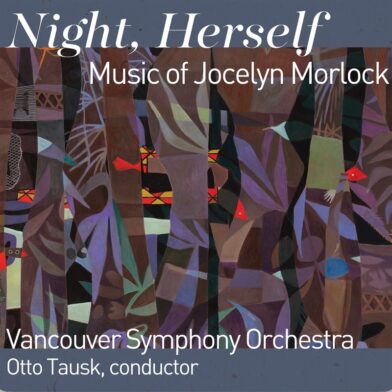
From 2014-19 Jocelyn Morlock was the Vancouver Symphony Orchestra‘s composer-in-residence—the frst woman to occupy this role. Night, Herself, the second in a series of forthcoming albums of Morlock’s music coming from Vancouver’s Redshift Records, emerges directly from her tenure with the VSO, with the orchestra (and members thereof) performing five of her works under the baton of Otto Tausk, who succeeded Bramwell Tovey toward the conclusion of Morlock’s residency. It follows the acclaimed recording Artemis Sleeps from earlier this year.
Night, Herself begins with the titular composition, which is also this collection’s longest piece. This fifteen-minute piece serves as an ideal opener for this set, and perhaps even as an introduction to Morlock’s music. Born in December 1969, Morlock matured musically at a time when compositional pedagogy was shifting away from the compulsory serialism that characterized the education of the previous generation. As such, she emerged wielding a stylistic amalgam that is very much its own. Morlock’s music digests a plethora of historical reference points while comfortably inhabiting a soundworld that is simultaneously inquisitive and luminously accessible.
Night, Herself (2017) pulls material from Henry Purcell’s song See, even night herself is here and while baroque music audibly suffuses certain passages, listeners might also sense the presence of Bartók, Tavener, Reich, Ravel and Mahler at various points throughout. Morlock clearly delighted in the sonic panorama afforded by orchestral forces here, unfurling a surging, unpredictable form that crosses an assortment of musical terrain.
Earthfall(2015) sits at a similar stylistic nexus, but the result is drastically different from the outset. The initial three minutes chart an upward trajectory propelled by insistent interlocking fgures that stack on top of one another, blending minimalist drive and romantic-era expressiveness. Yet toward the end of this opening gesture, the brooding, minor-key cogs that comprise this machine begin to melt as feverish smears of dissonance cloud the image. This dissolution sets the stage for the ensuing nine minutes which explores keening swirls of colour.
1998’s Blue Sun not only presents a sizable chronological jump, it also represents a notable contrast in style and instrumentation. A twelve minute duet for violin and viola, it alternates between intimate lyricism, gauzy textural sections, and occasional moments of impassioned, muscular playing. According to Mark Takeshi McGregor’s liner notes, the piece refects her interest in folk music, or rather “the moods that such music could inspire in a listener, long after the fnal notes have sounded. She likened this sensation to a “blue sun”: that ghost image of the sun that lingers in one’s vision after looking at the real one.” Though the piece was written some 25 years prior to the untimely end of her career, it features several traits that characterize her later output—a bold melodic sensibility, a deep fascination with sound colour, and perhaps most of all, a commitment to her personal and refined brand of formal peculiarity.
Originally commissioned by the Brandon Chamber Players, Solace (2001) is another earlier work that foregrounds a duo of bowed instruments, with the violin and cello exchanges set afoat by a weightless chorus of sustained strings beneath them. The sonic effect recalls Ives’ The Unanswered Question, particularly the “Silence of the Druids” evoked through its slow, muted string figures. Morlock’s own division of the ensemble into three distinct layers further reinforces the connection. She has what she terms the “early music” ensemble, consisting of two violins, two violas, cello and double bass, playing music that derives from the Agnus Dei of Josquin’s L’Homme Arme (sexti toni) Mass. There’s also ethereal veneer provided by five violins who hover above the rest of the ensemble, articulating long harmonics. Then, of course, there are the soloists, whose nimble, ornamented material functions in response to the frst subgroup. Whereas Ives’ strata produced a mysterious heterogeneity, Morlock’s are decidedly interconnected, making the slower layers feel like ghostly resonances or premonitions of the soloists.
O Rose (2018) also makes inventive use of an existing musical work, specifcally Mahler’s song Urlicht, best known as the fourth movement of his Symphony No. 2 in C minor, “Resurrection”. Morlock composed the piece as an accompaniment for Mahler’s symphony, to be performed on a VSO bill that bid farewell to its outgoing conductor Bramwell Tovey. O Rose bears a dedication to Tovey and the orchestra, “with admiration and deep respect.” Urlicht is quintessentially Mahlerian, containing some of his most evocative melodic contours cast within a yearning, melancholic frame. Though Morlock draws on elements of Urlicht in O Rose, the work’s relationship with Mahler extends beyond that particular song and the emotional world it inhabits. Mahler’s music abounds with shocks of perverse humour, bludgeoning sturm und drang, morbid symbolism, and scattered references to itself; O Rose celebrates and amplifes this strangeness.
Jocelyn Morlock (1969 – 2023) was one of Canada’s leading composers. Remembered for music that is at once lyrical, quirky, and deeply rooted in emotion, Morlock was born in Saint Boniface, Manitoba. She studied piano and composition at Brandon University with Robert Richardson Sr., Gerhard Ginader, and T. Patrick Carrabré, before moving to Vancouver in 1994 to complete her Masters and Doctoral degrees at the University of British Columbia with Stephen Chatman, Keith Hamel, and Nikolai Korndorf.
Morlock cited “birds, insomnia, nature, fear, other people’s music and art, nocturnal wandering thoughts, lucid dreaming, death, and the liminal times and experiences before and after death” as various sources of inspiration for her music. In the early years of her career, she performed as a member of UBC’s Gamelan Gita Asmara; the vigorous sound world of Balinese gamelan would inform much of the music she composed thereafter, bringing a rhythmic counterpoint to her expressive melodic writing. Her love of birdsong also audibly shaped her instrumental writing; her melodies were often unconventionally virtuosic, capricious, and delicate.
Morlock frst received international acclaim at the 1999 International Society for Contemporary Music’s World Music Days with Romanian performances of her quartet Bird in the Tangled Sky. A prolifc composer of vocal, choral and chamber music, Morlock wrote the imposed vocal work for both the 2005 Montreal International Music Competition (Amore) and the 2008 Eckhardt-Gramatté National Music Competition (Involuntary Love Songs). Her substantial body of vocal music highlights important relationships she nurtured with many Canadian writers and poets, including Alan Ashton, Tom Cone, Bill Richardson, and the Winnipeg writer and comedian Lara Rae, with whom she collaborated for an unrealized opera project. Morlock’s Exaudi (2004), commissioned by the vocal ensemble musica intima for a premiere performance with cellist Stephen Isserlis, remains one of her most beloved and performed works.
Morlock’s music has been recorded by numerous artists and ensembles. Within her lifetime the Canadian Music Centre’s Centrediscs label released two full-length portrait albums: Cobalt (2014) and Halcyon (2017). Her memory and legacy are carried on by a team of friends, musicians, and composers who were strongly connected to her life and work.
Founded in 1919, the Grammy- and Juno-award winning Vancouver Symphony Orchestra is the third largest orchestra in Canada, the largest arts organization in Western Canada, and one of the few orchestras in the world to have its own music school. Led by Music Director Otto Tausk since 2018, the VSO performs more than 150 concerts each year, throughout Vancouver and the province of British Columbia, reaching over 270,000 people annually. On tour the VSO has performed in the United States, China, Korea and across Canada. The orchestra presents passionate, high-quality performances of classical, popular and culturally diverse music, creating meaningful engagement with audiences of all ages and backgrounds.
In addition to being the Music Director of the Vancouver Symphony Orchestra, Dutch conductor Otto Tausk is also the newly announced Chief Conductor of recently formed Phion Orkest van Gelderland & Overijssel. Until spring 2018, Tausk was Music Director of the Opera Theatre and Tonhalle Sinfonieorchester St. Gallen. He appears as a guest with such orchestras as Concertgebouworkest, Rotterdam Philharmonic Orchestra, Netherlands Radio Philharmonic Orchestra, Danish National Symphony Orchestra, Lahti Symphony Orchestra, Stuttgarter Philharmoniker, Philharmonie Sudwestfalen, Orquesta Sinfónica de Galicia, Orchestra Sinfonica di Milano Giuseppe Verdi, Los Angeles Philharmonic, Orchestre symphonique de Québec, Melbourne Symphony Orchestra, the Mariinsky Orchestra, the orchestras of Perth, Tasmania, Auckland, BBC Scottish Symphony Orchestra and BBC National Orchestra of Wales, with whom he made his BBC Proms debut in August 2018. He is a hugely respected musical personality in his native Holland, working with all its major orchestras and composers.